The Apparition Period 1949–1952
Apparition Period
Pictures of the apparitions by Elisabeth Ruzicka
further pictures of the apparition period
The manifold apparitions and visions of the seven visionary girls of Heroldsbach began on 9 October 1949 with the sign of the Triune God above the little birch grove on the edge of the park of Castle Thurn. It consisted of the three letters JSH in green, brightly shining script: the Hebrew J for “Yahweh“, the Greek H for “Hyos“ and the Roman S for “Spirito Santo“, placed in the middle and slightly higher. Immediately afterwards the Most Blessed Virgin Mary appeared for the first time with hands folded in prayer; dressed all in white, she stood above the birch trees. Red roses shone on her feet. A black rosary hung on the right from her belt. From the third day of the apparitions onwards, Mary also carried the Child Jesus on her left arm.
In the three-year apparition period, up to 31 October 1952, the Mother of God showed herself mostly in a blue cloak and with a golden crown, but also in robes of other colours. The symbolism of the colours corresponded in each case to the content of the apparitions. The Mother of God insistently called for prayer, penance and atonement: The faithful should implore the light of God’s grace in prayer, receive it in a humble spirit of penance and let it flow out in forgiving love of neighbour. Thus prayer becomes effective for the salvation of souls.
After the Mother of God had remained at a distance above the birch trees during the first three months, on 13 January 1950 and regularly thereafter she came closer. The visionary girls could touch the apparition like a living person and felt a strong current of power flowing into them as they did so. It was the same when they touched the Child Jesus, whom they were even allowed to carry on their hands.
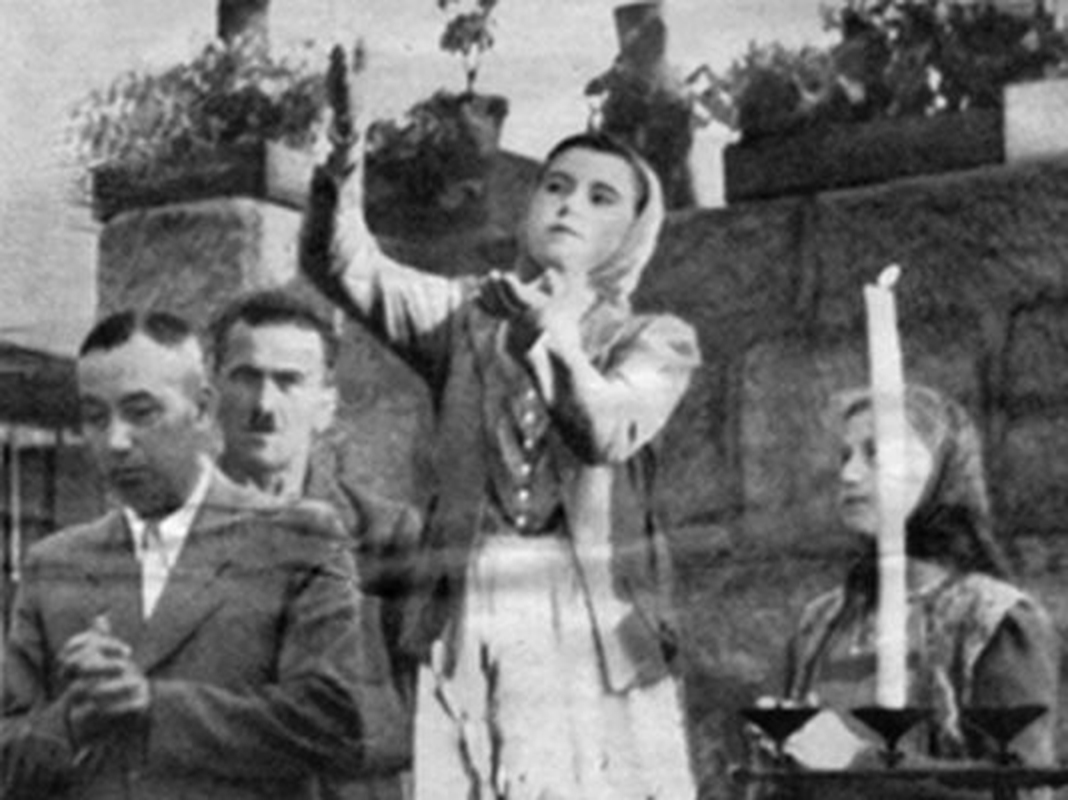
The Son of God appeared as the boy Jesus and as the adult Saviour, often as the Sacred Heart, as the Good Shepherd and as the Redeemer on the Cross. During apparitions of the crucified Saviour, the angels caught the blood streaming down in golden chalices. At the mystical communion the Angel of the Chalice handed the visionary girls a chalice from which they drank; he then divided a large white host and gave them the Body of the Lord as well.
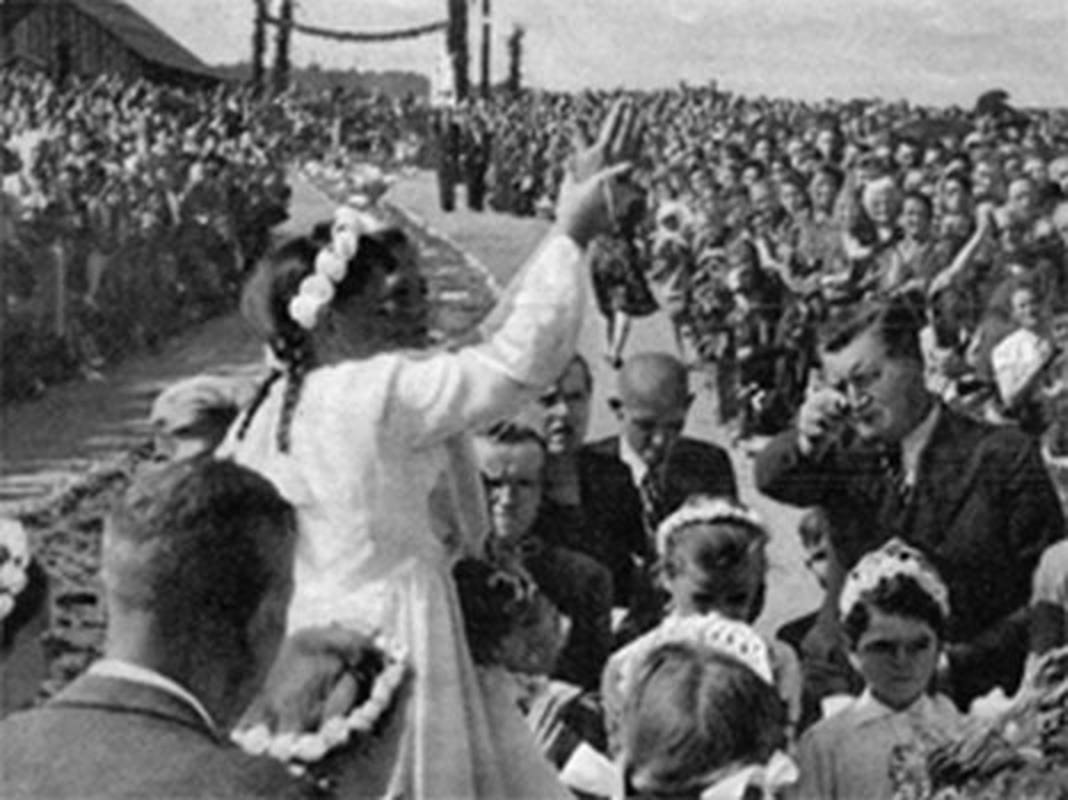
During the close apparitions the Mother of God often showed herself to the praying girls at the podium next to the wooden chapel. Mostly she floated from the birch grove, lying to the south, to the little altar at the lamppost, the place of encounter. Today this place is marked by the statue of the Immaculata standing in a copper shrine. From there the girls accompanied her to the podium. The path she took is still marked today by the rose beds laid out there. In the Rosary Chapel, the statue of Mary in the sanctuary marks the spot where the apparition stopped in front of the girls and there blessed the many thousands of the faithful again and again. As she did so, the miraculous light of grace flowed like streams of fire from her blessing hands to those who prayed. This supernatural light healed many sick people.
In the three years the heavenly apparitions came almost daily and often several times a day. Innumerable angels and saints also showed themselves, first of all St Joseph. Special importance was attached to the seven saints who represented a mission of their own: Pope Pius X, as envoy of the Eucharist; Brother Klaus and little St Thérèse as envoys of humility; Maria Goretti and Aloysius as envoys of chastity; Anthony and Crescentia of Kaufbeuren as envoys against demonic affliction. They are depicted in the painted triptych of the Altar of the Saints.
In the pilgrimage church the saints stand carved in wood on the side altars. St Joseph stands on the right in front of the sanctuary. The large bronze statue of the Rose Queen of Heroldsbach in the sanctuary shows the apparition’s typical gesture of blessing: the thumb and the little finger are closed in a circle, while the three middle fingers point upwards to the Most Holy Trinity.
On the holy mountain next to the chapel there are wooden crosses, which are still carried by pilgrims today.
On 31 October 1952 the Mother of God took her leave and, blessing, ascended into heaven. At this spot stands the Sacred Heart Altar.
A small nativity scene with the Child Jesus recalls Christmas 1951, when, at a vision of the nativity seen by the children, choirs of angels sang the praise of God. At this spot the Angel of the Chalice repeatedly gave the girls the mystical communion.
The place of the mystical communion later moved to an altar at the apple tree, about 100 metres away. Still further to the west, at the pear tree, there is a wayside shrine with the statue of the Child Jesus. He appeared there together with the guardian angels of the girls. Teachings were given on prayer and on how it becomes effective in the souls of those who pray. Instructive visions also took place on the so-called heavenly meadow.
A significant place on the holy mountain is the mystical source of grace. At the behest of the Mother of God the children had to dig here with bare fingers and later with spoons. They continued this activity for weeks. They depicted outwardly what is to come about inwardly, through prayer and penance, in the person who prays: immersion in the divine source of grace – Jesus Christ. At the bottom of the dug hole they also had to embed a large stone (cf. “The parable of the treasure hidden in a field” Mt 13:44 and “The stone which the builders rejected has become the cornerstone” Ps 118:22). The Mother of God said of this: “From this many graces will flow.“
The gift of grace surpassing all others were the visions of the Most Holy Trinity. The children were allowed to cast a glance into heaven and looked into the glory of the eternal light. Afterwards all walked the great procession path in prayer, accompanied by innumerable angels and saints.
On 9 June 1951 the Mother of God revealed her apparition title for Heroldsbach: “I am the Queen of Roses, I am the Rose Queen.“ Then the visionary children saw the golden crown which the Mother of God wore on her head float up towards heaven, while a wreath of roses came down from heaven and settled around Mary’s head. On the next day the Mother of God repeated: “I am the Rose Queen; do not confuse it with the Queen of the Rosary.“
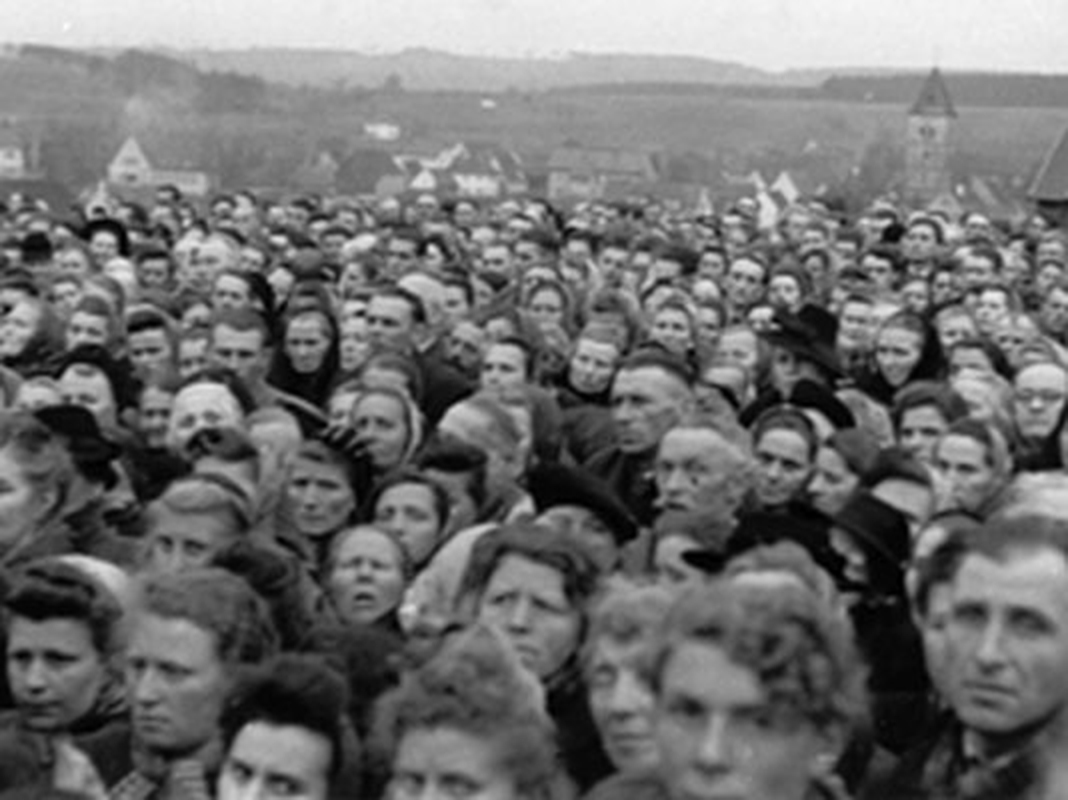
As a sign of the authenticity of the apparitions the Mother of God granted numerous answers to prayer. She also worked many miraculous healings, even in hopeless cases. The mere fact that thousands of people prayed with fervour for hours, day and night, in all weathers, and, deeply moved, experienced a new religious awakening, was a gift of grace. When people prayed devoutly, the children saw heaven open and the light of God streaming down like a rain of fire in a tower of light. Sometimes it turned into innumerable shining roses, a symbol of grace and of divine love. The Mother of God promised: “If people pray here, I will always be with you.“
The great miracle of the sun (similar to Fatima) of 8 December 1949, which was seen by about 10,000 pilgrims, among them 5 priests, may also be regarded as a sign of the authenticity of the apparitions. This divine sun of grace came down to the birch grove, where it opened. Within it stood the Mother of God, all in white with a golden crown.
On 2 February 1950 the great miracle of light took place, which was seen by about 70,000 pilgrims. The apparition grounds were enveloped in a mystical light. Streets of light, metres wide, went out in all directions. The pilgrims stood up to their waists in the radiance of this light, as in a golden-yellow sea of light. The Mother of God explained to the visionary children that on this day she had made visible the graces given to mankind.
The Mother of God showed herself publicly a third time. In the night leading to 1 November 1950, on which Pope Pius XII proclaimed the dogma of the bodily Assumption of Mary into heaven in Rome, the Mother of God showed herself to about 300 pilgrims to the right of the Forest Cross in the little birch grove. Shortly after midnight the darkness turned into a silvery-white light, out of which the Mother of God stepped. All the participants in the procession who were praying there could see the apparition. When those praying pressed towards the Mother of God, she floated slantingly upwards and backwards and vanished from their sight.
Contemporary Historical Parallels
On 7 October 1949, the Feast of the Rosary, the East German state, the GDR, was founded. On the same day Red China celebrated the constitutionalisation of its communist power. In the Russian visions the Mother of God said: “If the people do not fulfil my wish (prayer and penance), much blood will flow.“
In the foretold end times the Mother of God appears clothed with the sun: in Fatima on 13 October 1917, in Heroldsbach on 8 December 1949. It is perhaps also interesting to note that Heroldsbach lies at the midpoint of the straight line between Fatima and Moscow.
On 25 June 1950 the girls saw tears in the eyes of the apparition. To their question, “Dear Mother of God, why are you weeping?“ she explained: “Because the people do not listen to my requests“. A few hours later the news came over the radio that the North Koreans had crossed the 38th parallel, which triggered the Korean War.
On 31 October 1952 the last apparition took place in Heroldsbach. Exactly one day later the first American hydrogen bomb exploded.
On the 40th anniversary of the first apparition in Heroldsbach, on 9 October 1989, the great demonstration in Leipzig took place which, as the first peaceful revolution, led to the fall of the Wall and of the Iron Curtain.